We’re entering the final round of 2026 Reinventing Delaware, and we’re proud to spotlight the standout ideas that rose to the top.
This year’s finalists have dedicated significant time and effort to sharpening their ideas and building models for long-term success. They’re committed to innovative solutions that tackle meaningful challenges across Delaware, drive economic growth, and deliver real impact.
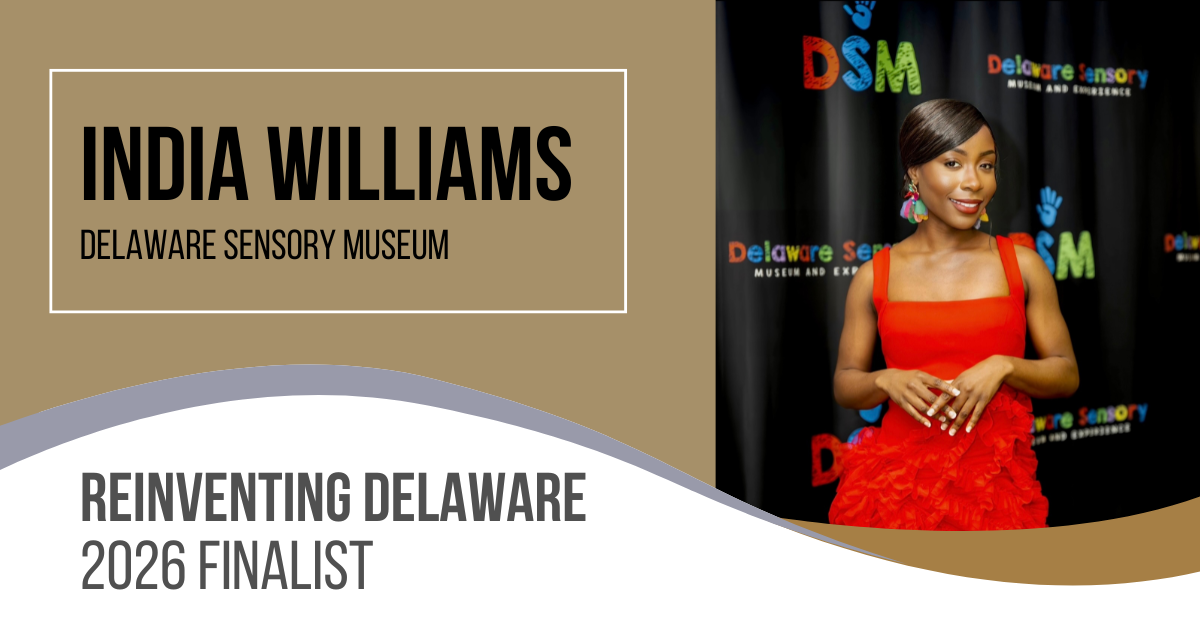
Our first featured finalist is the Delaware Sensory Museum, championed by India Williams. In our interview, she shares more about her vision:
How would you describe your idea in a 30-second pitch?
The Delaware Sensory Museum is an inclusive, interactive space designed for children of all abilities, especially neurodivergent learners, to play, regulate, learn and grow in a safe and sensory-rich environment. We aim to bridge the gap between therapy, education, and community through immersive exhibits, developmental programming, caregiver support, and workforce development pathways that train educators, caregivers, and young adults in inclusive practices.
Our hybrid model blends earned revenue with partnerships across health care, education, and community organizations to improve early childhood outcomes, strengthen families, and build a more inclusive workforce. DSM is more than a museum. It’s a developmental ecosystem designed to change life trajectories.
What inspired you to pursue this idea, and why does it matter right now?
The idea for DSM grew from lived experience. As a parent navigating neurodivergence, I saw firsthand how fragmented and inaccessible supportive environments can be for children and families. Many spaces felt clinical, restrictive, or not designed with sensory and developmental needs in mind, leaving a gap between therapy, education, and everyday community life. I began envisioning a place where children could regulate, explore, and grow within an inclusive and welcoming environment.
Through continued research and conversations with families, educators, and community leaders, it became clear that the need extended beyond children. Caregivers needed support. Communities needed education. There was also an opportunity to build workforce pathways in inclusive practice.
The need is urgent. Rates of neurodivergence and developmental challenges are rising. Families struggle to access coordinated support, and communities recognize the importance of early intervention and inclusive infrastructure. At the same time, workforce shortages in education, health care, and human services continue to grow. DSM responds to these converging challenges by supporting children early, strengthening community systems, and preparing a more inclusive workforce for the future.
In what ways will your idea benefit Delaware?
DSM strengthens Delaware across social, educational, and economic dimensions. It improves early childhood and developmental outcomes by providing an inclusive and sensory-rich environment where neurodivergent and neurotypical children can regulate, learn, and build critical life skills outside clinical settings. This supports families, reduces stress, and promotes long-term positive outcomes for children.
DSM also advances workforce and economic development by creating jobs; training educators and caregivers in inclusive practices; and building pathways for young adults entering education, health care, and community services. It attracts regional visitors, increases local economic activity, and positions Delaware as a leader in inclusive innovation.
By bridging health care, education, and social services, DSM strengthens community infrastructure and expands awareness, access, and equity for neurodivergent individuals and their families. The result is a more inclusive, prepared, and resilient Delaware.
How are you planning to achieve your idea’s purpose?
We are advancing DSM through a phased, partnership-driven approach. First, we are securing strategic capital and public-private partnerships to support facility development, sensory exhibit design, and initial operations. We are also piloting programs with families, educators, and community partners to validate demand, refine programming, and build early impact.
We are developing a hybrid sustainability model that blends earned revenue—including admissions, memberships, and programs—with grants, corporate sponsorships, and partnerships across health care, education, and government. This approach supports long-term operational stability while keeping the mission central.
Finally, we are building a strong ecosystem around the space by training staff and community partners in inclusive practices, developing workforce pathways, and collaborating with schools, health care providers, and community organizations. The goal is not simply to open a facility, but to establish a sustainable system that supports children, families, and communities over time.
Who specifically will benefit from your idea, and what impact would you like to see?
DSM directly benefits neurodivergent children and their families, particularly those navigating autism, sensory processing, and developmental or learning differences. It also serves neurotypical children through inclusive play and learning that fosters empathy, social connection, and understanding across abilities.
Caregivers benefit from supportive programming, resources, and community connections, while educators, therapists, and service providers gain access to training and workforce development in inclusive practices.
Broader benefits extend to Delaware’s education, health care, and community systems by strengthening early intervention, reducing long-term disparities, and improving family stability. The museum also creates workforce pathways for young adults and professionals entering education, health care, and human services, contributing to a more prepared and inclusive workforce.
The long-term impact includes improved developmental outcomes for children, stronger families, expanded access and equity for neurodivergent individuals, and a more inclusive and resilient Delaware.
Will you or someone other than yourself champion this idea should it continue to move forward, and why? If applicable, who else is on your team?
I will continue to champion this vision as its founder, guided by lived experience and a long-term commitment to improving outcomes for neurodivergent children, families, and communities. I am building the systems, partnerships, and infrastructure needed to ensure the work grows beyond any one individual.
DSM is supported by a growing network of partners and advisors across education, health care, community development, and philanthropy. The team includes board members, strategic advisors, educators, therapists, community partners, and workforce development leaders with expertise in program design, operations, fundraising and inclusive practice. Together, this collective leadership helps ensure the vision remains sustainable, community-rooted, and positioned for long-term impact.
What advice would you give to an aspiring entrepreneur?
Build relationships, not just a business. Strong partnerships and meaningful connections often shape long-term success more than any single strategy. Stay grounded. Growth requires patience, humility, and the ability to keep moving forward, even when outcomes are uncertain.
Anything else you would like to add?
This work focuses on strengthening families, expanding access, and shaping a more inclusive future for our communities. Meaningful change happens when public, private, and community partners work together. I look forward to continuing to refine and grow this vision in ways that benefit Delaware over the long term.
Next Steps: Finalist Announcement
After collaborating with our Idea Development team at Social Contract, our review committee—including PDFF staff, board members Thère du Pont and Jacqueline Disabatino Flowers, Scott Malfitano, Chair of the Delaware Workforce Development Board and Vice President at CSC, Ted Lauzen, Partner at Grey Fox and Yvonne Deadwyler, President and CEO of the New Castle County Chamber of Commerce—will select an award recipient.
The top idea will be announced at a special press event, and the finalist chosen will receive a $15,000 grant to implement their concept, driving economic growth, creating jobs, and making Delaware an even better place to live and work.
Thank You to Our Sponsors
Sponsorship opportunities are available to support the development of each finalist, as well as the dinner this November. Stay tuned for the date!
Join Our Mission in 2026
We are currently seeking additional supporters and sponsors for the next phase of the program. By underwriting development services or making a donation, you can play a crucial role in fostering innovation and driving economic growth in Delaware.
For more details on getting involved with the Reinventing Delaware initiative as a sponsor, contact Lynn Roberts at [email protected]. You can also visit our donation page to support the idea development program. Your contribution helps invest strategic, practical resources to position businesses for success, ultimately creating jobs and improving our community.